
Shyamaji and his journal can open doors to new avenues in Sociology. It is high time we give Shyamaji his due place in Indian Sociology and History
To read full article, click: TISC Student Column: Shyamaji Krishnavarma and The Indian Sociologist or read below
George Graham Vest, former US Senator from Missouri, was largely remembered for one reason. It is because of what he said in a speech delivered in 1891: “In all revolutions the vanquished are the ones who are guilty of treason, even by the historians, for history is written by the victors and framed according to the prejudices and bias existing on their side”. There could be less disagreement with what he said. History continues to be unfair to many people and events of the past. Recent interest that is forming around Subaltern Studies gives a hope that much of what is ignored and unheard about the past will finally find its place in history. In this essay, I would like to point out one chapter in the past which is forgotten in the history of the development of sociology – Shyamaji Krishnavarma’s The Indian Sociologist.
In the context of tracing the development of Indian Sociology, significant contributions have been made by A. R. Desai through his magnum opus ‘Rural Sociology in India’ and by M. N. Srinivas and M. N. Panini in their paper ‘The Development of Sociology and Social Anthropology’. In both these works, there are no references to The Indian Sociologist or Shyamaji Krishnavarma. Only a passing reference is made to Shyamaji in A. R. Desai’s seminal work ‘Social Background of Indian Nationalism’. Nothing can be said about why it did not receive the attention it deserves. But I believe Shyamaji’s intellect and archives of his journal (which are not easily accessible) are a valuable source to understand Indian Sociology. I came across Shyamaji for the first time in Mahatma Gandhi’s autobiography. During his visit to London, Gandhi stayed at ‘India House’ founded by Shyamaji. It hosted many prominent Indian nationalists like Bhikaji Cama, Lala Har Dayal, Savarkar, and Madan Lal Dhingra. It was in this house that Gandhi had his first encounter with V. D. Savarkar. This aroused my interest to know about Shyamaji and his contributions.
The main source of this essay is A. M. Shah’s article titled ‘The Indian Sociologist, 1905-14, 1920-22’, which is the most valuable source to know about The Indian Sociologist journal and its founder.
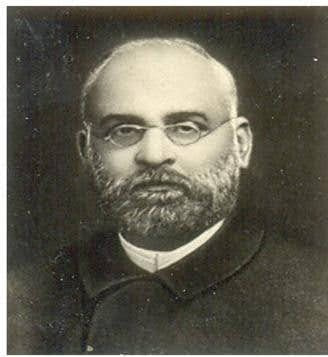
Shyamaji was born in Gujarat in 1857. He attended high school in Bombay at Wilson High School and then attended Elphinstone College. He worked closely with the Arya Samaj and its founder Dayanand Saraswati. He went to Oxford in 1879 where he studied Sanskrit, Greek, Latin, logic, law, political economy and some other subjects. In 1888 he returned to India and worked in various positions for 10 years.
Shyamaji was drawn towards the freedom movement because of the humiliation he faced in his workplace from British people. He was inspired by extremists like Bal Gangadhar Tilak. He decided to locate the struggle against the British in their own country and moved to London in 1897, resolving to move the public opinion of the British citizens towards the conditions of Indians. With this intention, he started India House and the Indian Home Rule Society to bring together Indian students in London and fill them with the spirit of Nationalism. In 1905, he founded The Indian Sociologist, a monthly periodical to reach wider audiences and generate more discussion. He had to stop this journal in 1914 because of various pressures and revived it from 1920 till 1922. It is not the scope of this essay to go into its troubled history. Instead, the focus here will be on the contents of The Indian Sociologist.
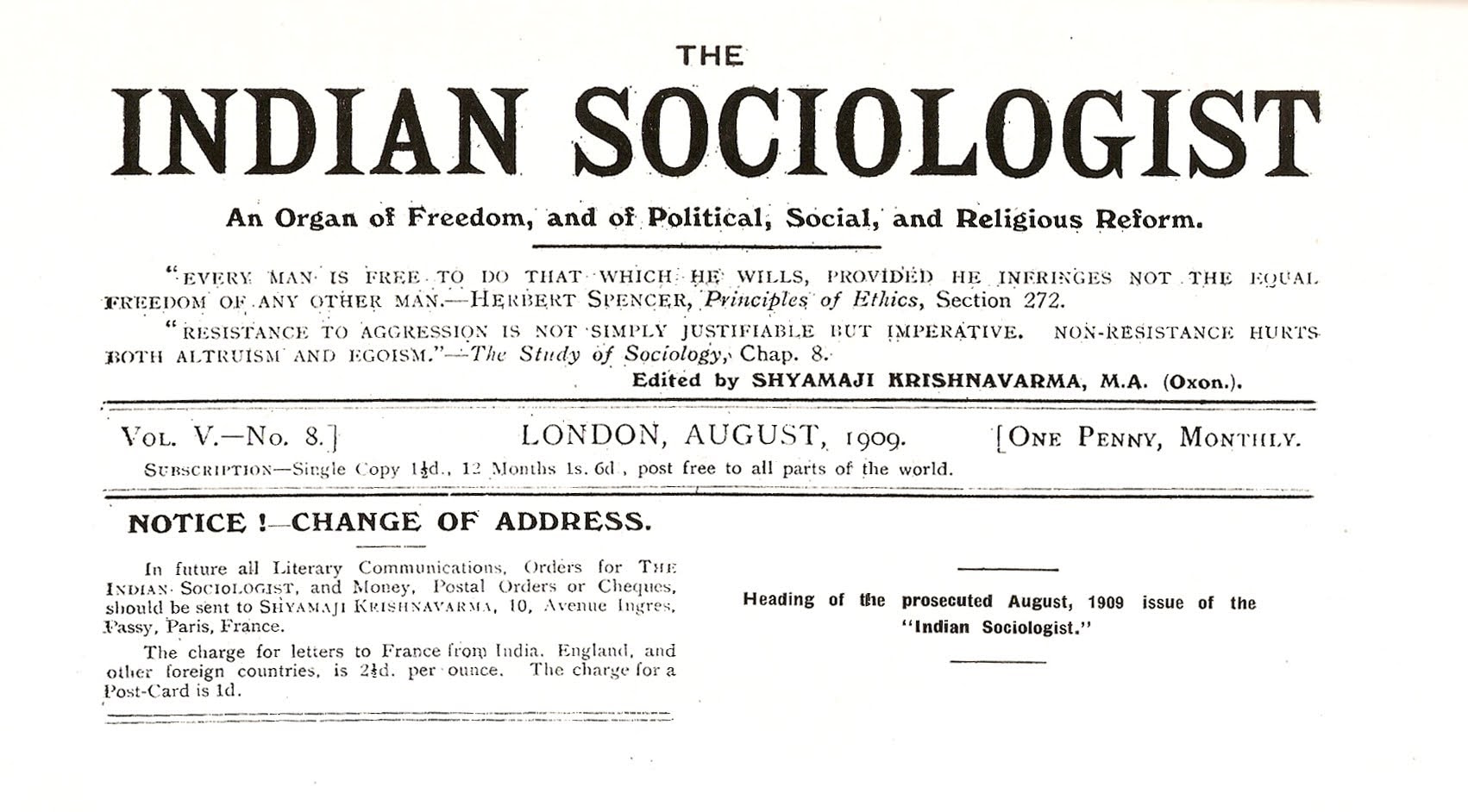
Beginning in 1905, The Indian Sociologist was brought out with a subtitle: ‘An Organ of Freedom, and Political, Social, and Religious Reform’. In the editorial statement of its first issue, Shyamaji wrote:
“The appearance of a journal conducted by an Indian sociologist in England is an event likely to cause surprise in some quarters; but there are many weighty grounds to justify such a publication. The political relations between England and India urgently require a genuine Indian interpreter in the United Kingdom to show, on behalf of India, how Indians really fare and feel under British rule. No systematic attempt has, so far as our knowledge goes, ever been made in this country by Indians themselves to enlighten the British public with regard to the grievances, demands, and aspirations of the people of India and its unrepresented millions before the bar of public opinion in Great Britain and Ireland This journal will endeavour to inculcate the great sociological truth that “it is impossible to join injustice and brutality abroad with justice and humanity at home.” It will from time to time remind the British people that they can never succeed in being a nation of freedom and lovers of freedom so long as they continue to send out members of the dominant classes to exercise despotisms in Britain’s name upon the various conquered races that constitute Britain’s military empire.
The Indian Sociologist will not be identified with any political party. It will be guided in its policy by the fundamental truths of social science, the first principle of which is that “every man has freedom to do all that he wills, provided he infringes not the equal freedom of any other man”. In discussing political, social, and religious questions, we shall frequently appeal to sociology, which, as expounded by the founder of that new and profound science, proves conclusively that “all despotisms, whether political or religious, whether of sex, of caste, or of custom, may be generalised as limitations to individuality, which it is the nature of civilisation to remove”.
His commitment to two objectives: achieving freedom for India and informing the public opinion of British about Indians’ situation, is reflected in the lines above. Another interesting observation is that the two sentences enclosed in double quotes are from the works of the famous sociologist Herbert Spencer. In all the issues of The Indian Sociologist, Spencer was hugely quoted.
Shyamaji had a great admiration for Spencer. After Spencer’s death, he offered £ 1000 to start the Herbert Spencer Lecture in his memory at University of Oxford. Shyamaji also founded ‘Herbert Spencer Indian Fellowships’ for Indian graduate students who wanted to study in England. Shyamaji emphasised on Spencer’s works to support the cause of Indian freedom. There is no research that has been done on Spencer’s points of view of India. Marx and Weber’s views on India are widely acknowledged. Historian Irfan Habib compiled a volume on Karl Marx’s writings on India, however, similar work on Spencer is not found. Spencer was a huge proponent of freedom and resistance. One quote which was often printed below the title of The Indian Sociologist was: “Resistance to aggression is not simply justifiable but imperative. Non-resistance hurts both altruism and egoism. (The Study of Sociology, Chapter 8)”. Is this commitment to Freedom generally directed towards Indian cause, or did Spencer have India specifically in his mind? To answer this question, there is a need to delve into the works of Spencer.
The Indian Sociologist published wide-ranging articles on the Indian National Congress, Indian Flag and Anthem, Passive Resistance, Swarajya, Indian Universities, Indo-US relations, Government Services versus Independent Services, etc. All these articles put together are capable of acting as a huge repository which can aid in understanding the history of Indian Sociology. They add a significant amount of knowledge to Indian sociology, contributing to the development of the discipline.
Vishnu Pandya and Arati Pandya collected with great trouble all the issues of The Indian Sociologist from 1905-1908 and compiled them in a book titled Azadi Jangnu Patrakaratva: Landanma Indian Sociologist. This book on the history of The Indian Sociologist is written in Gujarati, but all the issues of the journal in English are attached. It is now important to bring this book into greater circulation and make it easily accessible. Efforts had to be made to collect the journal issues post-1908. This would be a great contribution to Indian sociology and history. Shyamaji and his journal can open doors to new avenues in Sociology. It is high time we give Shyamaji his due place in Indian Sociology and History.
Bibliography
- Pandya, V., & Pandya , A. (1997). Azadi Jangnu Patrakaratva: Landanma Indian Sociologist. Ahmedabad: Samantar Prakashan.
- Shah, A. M. (2006, August 5-11). The Indian Sociologist, 1905-14, 1920-22. Economic and Political Weekly, 3435-3439.
- Srinivas, M., & Panini, M. (1973, September). The Development of Sociology and Social Anthropology in India. Sociological Bulletin, 179-215.
 rishvanth.com
Leave a comment