“The price of anything is the amount of life you exchange for it” – H.D. Thoreau
French Philosopher Michel de Montaigne said, “that to Philosophize is to Learn to Die”. This pessimism is shared by a plethora of thinkers for more than two and a half-century until Thoreau published ‘Walden’ in 1854, a treatise that declared individuals as idyllic and nature as sovereign exemplifying lessons for man. The quintessential postulate espoused by Thoreau is that the serene nature that is around us always invites the man to unclip the potentials to live a simple, independent, and self-reliant life, and for Thoreau, any change in nature is possible through the activity performed by an individual in the world. Thoreau has surely foreseen the madness with which the drive for wealth and power will forge the people to exploit the tranquil nature and squeeze the life out of it.
An often-quoted saying from ‘Walden’ is that “the price of anything is the amount of life you exchange for it”. This statement epitomises Thoreau’s convictions and it is a classic antithesis of Montaigne’s conception- “that to Philosophize is to learn to live”. His quote is notable for four significant reasons. Firstly, the timing in which this book came out. In 1848, around six years before Walden was published, Karl Marx and Engels published ‘Manifesto of the Communist Party’ and the ideas of communism are slowly haunting the world. For Karl Marx and Friedrich Engels, an individual is subjected to his material conditions and he is the outcome of the circumstances. According to Marx, “It is not the consciousness of men that determines their being, but, on the contrary, their social being that determines their consciousness”. An individual is given less role, except in terms of collective action. But for Thoreau, any change begins from the individual and he is the centre of nature. Individuals are not altogether devoid of freedoms. Secondly, Individual and nature co-exist, and their existence is not antagonistic, rather mutually nurturing. The mysteries of nature are for man’s respite. Nature provides its resources, material and spiritual, for man and vice versa. It is wise to visualise nature and man as mutually nourishing partners, conditioned by an exchange.
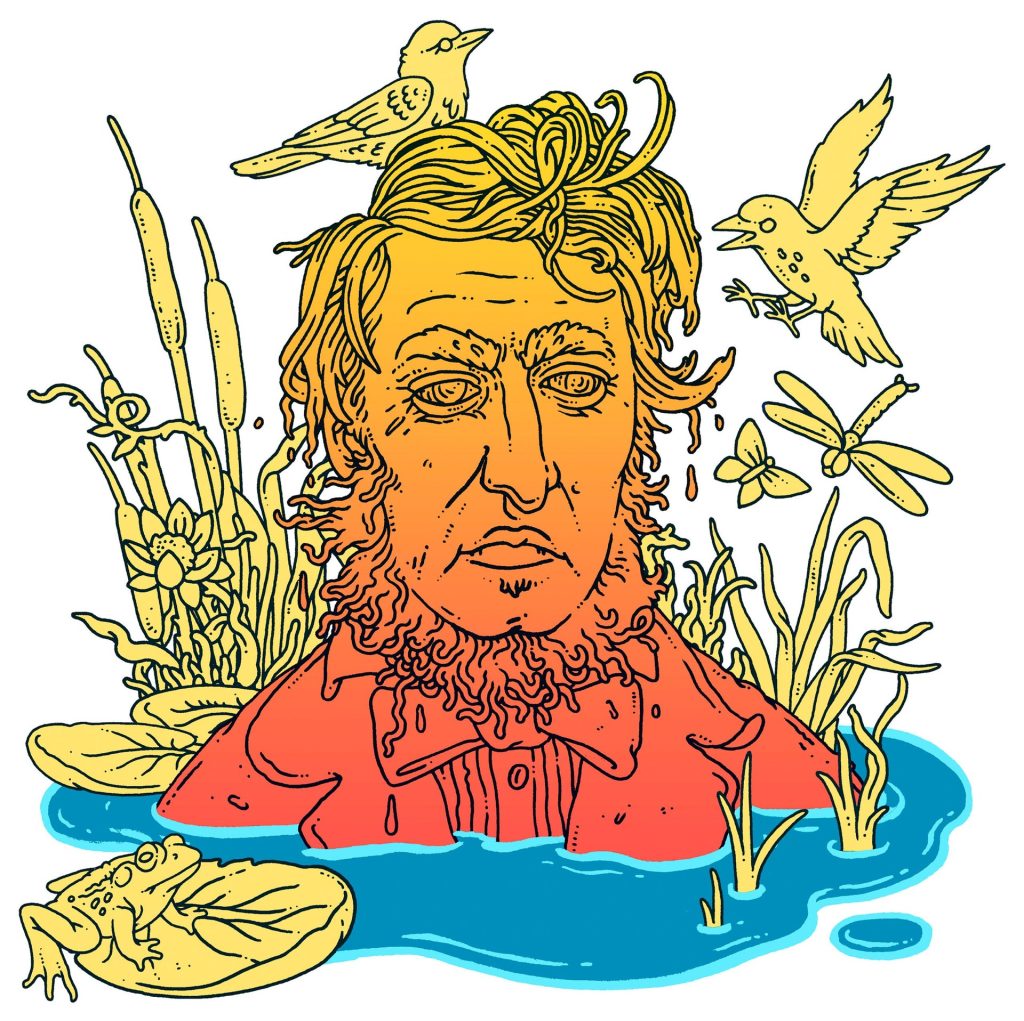
This brings us to the third theme, which is that man and nature act like opposite parties in a classic barter market. There is an inevitable exchange between nature and man, that goes beyond the terms of monetary and measurability. For example, if an individual wanted to build a large mansion only for himself in a poor country where people barely get a palm for shelter, he is trading off nature’s resources which could be available for all for himself. Here there are three exchanges made for his mansion- nature’s resources, the possibility to provide shelter for the poor and the happiness that he would receive by living a simple life amidst nature and other people. In other words, he is trading off the possibility to live a quality life. These tradeoffs deepen with man’s greed if he wants to set up industries that pollute the natural surroundings and exploit the labour of the working-class people. The notion of ‘life’ in Thoreau’s quote goes beyond an individual’s life. Mahatma Gandhi was influenced by Thoreau and has understood this idiom exceptionally when he conceptualised the ‘idea of trusteeship’ based on awareness of the limits of nature and the boundless greediness of human exchanges. He forged the rich to become “trustees of the welfare of the masses and by devoting their talents not to amassing wealth for themselves but to the service of the masses in an altruistic spirit” otherwise, “they will end either by destroying the masses or being destroyed by them”. Moving beyond the parochial understanding of the material constraints exposes the ugliness of mindless human indulgences. Thoreau’s idea of life could be futuristic in the sense that excessive usage of nature will jeopardise the ability of future generations to make exchanges.
Lastly, Thoreau implicitly propounded a startling proposition- man is a free being and he makes the exchanges. The amount of life that needs to be exchanged is a choice every individual has to make. He can limit or choose not to. Thoreau anticipated the impulses of sustainability, a modern concept. By limiting the desires, an individual needs can decrease the amount of life that needs to be exchanged and hence, protect the environment. Reformation starts from the individual. This idea brings to my memory what Mother Teresa once said, “If each of us would only sweep our own doorstep, the whole world would be clean”.
Thoreau quote holds a significant lesson for the present that reformed individuals would amass to a reformed and sustainable world. Humans need to move beyond the monetary terms in making choices by looking through the inhuman exchange of resources in the world. It is the need of the hour for humanity to learn to live sustainably in the company of fragile and serene nature.
 rishvanth.com
Leave a comment