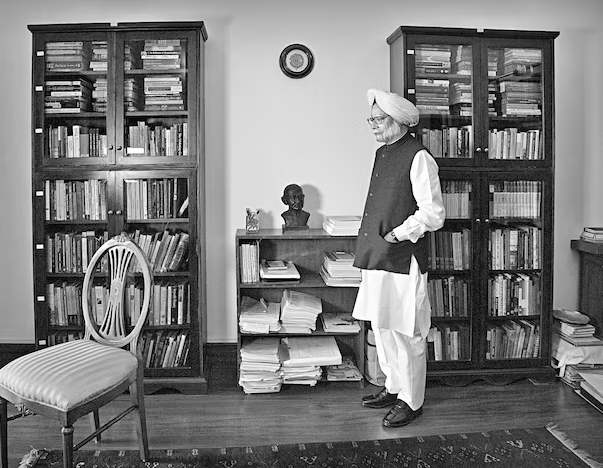
We will have to wait a decade or two for some scholars to dig out archives, conduct a wide range of interviews and write serious and critical biographies of Dr Manmohan Singh. Till then, what we have of him are the reminiscences of people who knew him, a book and a movie with clickbait title, newspaper tributes, some hagiographies, and 6 volumes of his collected works, rightly titled ‘Changing India’. Apart from there, a widely circulated narrative and public memory about him.
In an article titled ‘A Tale of Two Manmohan Singhs’, Journalist Indrani Bagchi writes, “Through the longest serving administration of any prime minister since Nehru, India’s economist-politician has failed to reform either the economy or the government”. While he is much touted for the 1991 Economic Reforms, the 2006 India-United States Civil Nuclear Agreement, and efforts to broker a peace deal with Pakistan during his tenure despite terrorist attacks in Mumbai in 2008, he was undermined otherwise. He was accused of lethargy, indecision, wasteful spending and turning a blind eye to the corruption under his regime as Prime Minister. But the real Manmohan Singh certainly is bigger than all these accusations.
Manmohan Singh means business. He was brought in as Finance Minister by P.V. Narasimha Rao to bring the Indian economy back on track from the serious balance of payments crisis. When Rao offered him the job of Finance Minister, the terms of reference Rao set for Manmohan Singh were quite clear: to bring reforms with a human face. Manmohan Singh said he “will accept this only if [he] get his full backing”. Rao replied, “You will have a free hand. If the policies succeed, we will all take the credit. If it fails, you will have to go”.
Manmohan Singh got down to his job to fasten reforms, and Rao took care of politics, defending both Singh and his reforms. During that period, Manmohan Singh quoting Victor Hugo, said, “No power on earth can stop an idea whose time has come….The emergence of India as a major economic power in the world happens to be one such idea”. He earned a sobriquet called, “1 per cent Singh”, given his emphasis on bringing the inflation rate down to 1 per cent. He brought in the best Economic minds to spearhead the reforms: Montek Singh Ahluwalia as secretary of economic affairs, and Ashok Desai as Chief Economic Consultant. The latter’s appointment came under fire because Desai, a pro-market economist replaced Deepak Nayyar, who is known for his left-of-centre inclinations. Singh sharply responded saying, “The Finance Ministry is not a debating society”.
In his book ‘PMs, CMs, and Beyond: Wheels Behind the Veil’, P.V.R.K. Prasad, who worked as Media advisor and Additional Secretary to the Prime Minister’s office under Rao tells him, “Dr Manmohan Singh is neither a full-fledged politician nor an officer…He does not understand that I am the target of their criticism [both opposition and members from his own party]. I can act against them, but I have to choose the right occasion and time. He is not bothered about such niceties. He says he is not a politician. How can he be a finance minister and still claim he is not a politician?”. Surely Rao had a tough time with Singh. But their duo worked well and undoubtedly transformed the Indian economy.
Unlike many other economists of his time, Manmohan Singh was dynamic in his approach. Take the case of a review he wrote for the book ‘India: Planning for Industrialization’ by Jagdish Bhagwati and Padma Desai. He writes, “There is certainly a need to recognise that the knowledge available to civil servants is not necessarily superior to that of entrepreneurs and that the fact that some direct controls are good does not mean that more controls are better that less controls”. But he quickly added later that, “It would be much too presumptuous to claim that modern neoclassical economics has answers to all economic problems”. While he inaugurated neoliberal reforms in India, Singh was aware of its limitations and the role of the state in providing welfare for its masses. This is explicitly evidenced by the launch of Mahatma Gandhi National Rural Employment Guarantee Act in 2005 to provide at least 100 days of guaranteed wage employment to rural workers.
After Dr Manmohan Singh won the 2008 vote of confidence against his government over the Indo-US Nuclear deal and the 2009 Loksabha elections, news channels ran visuals of the Prime Minister with a background song from then Akshay Kumar film ‘Singh is Kinng’. While Congress party tried to steal the victory from him, the nation knows the truth and he is back is business. Despite all the accusations against him, he remained a ‘King’.
Throughout his public life, Singh was steadfastly committed to his mission of transforming India. In 2010, speaking in Malaysia, he said, “India seeks rapid economic growth that will create wealth for our people and also generate surpluses to fund our ambitious social development programs, particularly in the areas of health, education, and environment protection. Second, we seek growth that creates employment and development that is socially and regionally balanced and inclusive. Third, we seek to build a modern, knowledge- and science-based economy to complement our agricultural and industrial base”. This vision stands timeless- something he strived for and a message for generations.
Dr Manmohan Singh will be remembered not as an accidental, but Prime Minister who meant business. His unwavering conviction to transform the Indian economy and policy, the professionalism with which he carried himself, his strategic approach to international relations during his tenure and his lifelong selfless public service make him one of the greatest leaders in contemporary India.
 rishvanth.com
Leave a comment