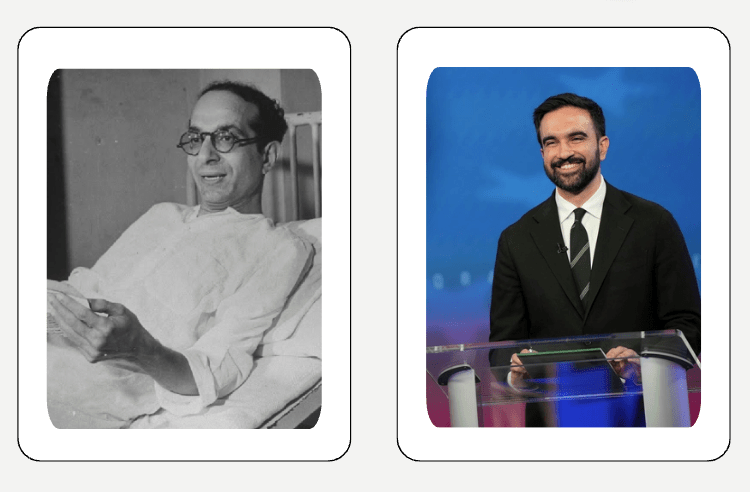
There is much traffic on internet about Zohran Mamdani, newly elected mayor of New York City, who describes himself as a democratic socialist and won in the city that was the capital of capitalism. One observer went on to ask if his win was a referendum on capitalism. While this is too early to answer, his success reminded me of an Indian Muslim, Yusuf Meherally, who was, in 1942, elected mayor of Bombay, a centre of Indian economic capital.
Yusuf was born in 1906. While he was initially under the tutelage of Jinnah, after the latter’s clarion call for Pakistan, Yusuf sided with Gandhi. He founded the Bombay Youth League in 1928 and organised protests against the Simon Commission. The slogan ‘Simon Go Back’ was coined by Yusuf. He was one of the founders of Congress Socialist Party and worked as its general secretary.
When he was arrested and kept in Lahore Central Jail (he became Mayor five days after his release), Yusuf demanded for the copy of the Old and New Testaments to read. He was refused by the jailer, saying, ‘You are a Mohammedan, you may get the Koran to read if you wish, but not the Christian Bible.’ Yusuf protested and started a hunger strike in jail. Soon, the authorities relented because they didn’t want the world to know that Yusuf were starving because they refused to give them the Holy Bible. When the jailer gave the Bible, Yusuf said that he wanted more books. The jailer took the list and arranged them all. The books included ‘Portrait of Mexico’ by Bertram D. Wolfe, an American writer and founding member of the Communist Party of America.
Wolfe and Yusuf met during Yusuf’s visit to New York, and they shared their views about India’s freedom movement in the USA. Yusuf said, “A hunger strike in a British jail could get me the Bible, or your book or other works to read. In Hitler’s jails or in Stalin’s, it would only have gotten me before a firing squad. If Gandhi had been in the Soviet Union, he would have disappeared forever from view after his first word of protest”. This underlines Yusuf’s discomfort with socialism in Stalin’s way and the merits of non-violent resistance, which he remained committed to throughout his life.
 rishvanth.com
Leave a comment