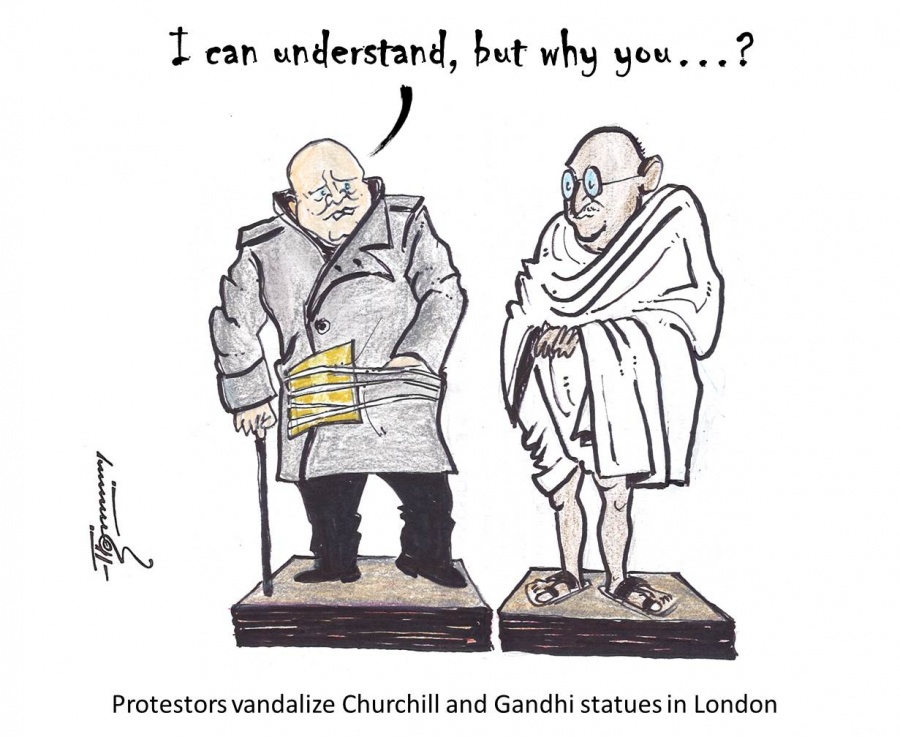
Mahatma Gandhi and Winston Churchill are contemporaries of their age. But they are completely two different poles divided by oceans and ideologies. One is the apostle of non-violence and another one is an exponent of war and bloodshed. Whatever they may be in their lives, both destined to the same fate in their own countries, where they lived and fought for. Relationship between these two contemporaries was described by Rajmohan Gandhi as ‘Vexed Relationship’. Gandhi and Churchill met for the first and the last time in 1906 in London when both not very well known figures. At that time, Churchill was colonial secretary and Gandhi was in England that time to seek imperial protection for South Africa’s Indians. This 1906 interview “was cordial enough, but the torchbearers of Empire were fated to clash” till their death.
One of the most remembered and popular clashes between these two figures occurred in February 1931, when Viceroy Lord Irwin invited Gandhi to the Empire’s grand mansion (Rashtrapati Bhawan) in New Delhi to talk about the dominion status for India. After this incident, Churchill wrote to Irwin that “a seditious Middle Temple lawyer now posing as a Fakir…striding half-naked up the steps of the viceregal palace to parley on equal terms with the King-emperor” (Churchill made a factual mistake here: Gandhi studied in Inner Temple and not the Middle Temple in London). What is more profound and less known is the subtle and cardinal reply of Gandhi on Churchill’s comments. Gandhi wrote to Churchill nearly fourteen years after Churchill’s comments in 1944. Here I reproduce the full text of that letter:
Dear Prime Minister,
You are reported to have the desire to crush the ‘naked-fakir’, as you are said to have described me. I have been long trying to be a fakir and that, naked- a more difficult task. I therefore regard the expression as a compliment though unintended. I approach you then as such and ask you to trust and use me for sake of your people and mine and through them those of the world.
Your sincere friend,
M. K. Gandhi
It is not known whether Churchill read this letter or not. But it is certain that no reply came from Churchill for this letter. What could have prompted Gandhi to write this letter is a derogatory message from Churchill to viceroy Lord Wavell in May 1944 where Churchill send him ‘a peevish telegram to ask why Gandhi hadn’t died yet’. This is speculation. But it surely reflects frank enmity that Churchill extended to Gandhi.
These two rivals shared such a ‘vexed relationship’ throughout their life. Arthur Herman in his seminal work Gandhi and Churchill: The Epic Rivalry That Destroyed an Empire and Forged Our Age drew an interesting parallel between these two. Both Churchill and Gandhi ended their lives getting “what they most wanted but at the cost of what they most treasured. Gandhi and Churchill both died as heroes to their fellow countrymen and as icons to the rest of the world. But what they are celebrated for achieving is not what they had set out to do”.
Churchill set to attain the imperial grandeur to his country. He lived and worked tirelessly towards this dream. His leadership in driving British to victory in World War II is a testimony for his vision. But Britons did not live up to his dreams. “Britons preferred to remain human beings rather than become heroes. To his sorrow, Churchill was left with fragments of his broken dream, including the dream of the Raj in India”.
Gandhi also set to create an Independent self-sufficient India with Ahimsa and Satyagraha as his weapons to bring down the mighty British empire. He sustained his dream throughout his struggle for freeing India from shackles of foreign rule. But when his goal was in sight, “his vision lost its values to others if not to him. Gandhi too was left with dream’s broken fragments, while India dissolved into chaos and violence. On the eve of Independence, India was partitioned and there is bloodshed in many parts of the country. Gandhi didn’t participate in the first Independence Day celebrations. Religious harmony and tolerance were an integral part of Gandhian ideals and finally, he was assassinated in the hands of a religious fanatic just months after Independence.
In short, “the world refused to be reshaped in either Churchill’s or Gandhi’s image….in Gandhi’s case, to a world without violence or exploitation, in Churchill’s, to a British Empire blossoming into a robust union of English-speaking peoples”. This is why it can be said that both were destined to a ‘common fate’. Here the problem is not to assess whose ideals were relevant or irrelevant, good or bad but it is important to realise how we have taken for granted their contributions and forgotten their visions. Gandhi and Churchill died sad men seeing their respective nations moving away from what they envisaged for it.

 rishvanth.com
Leave a reply to Bharath Cancel reply